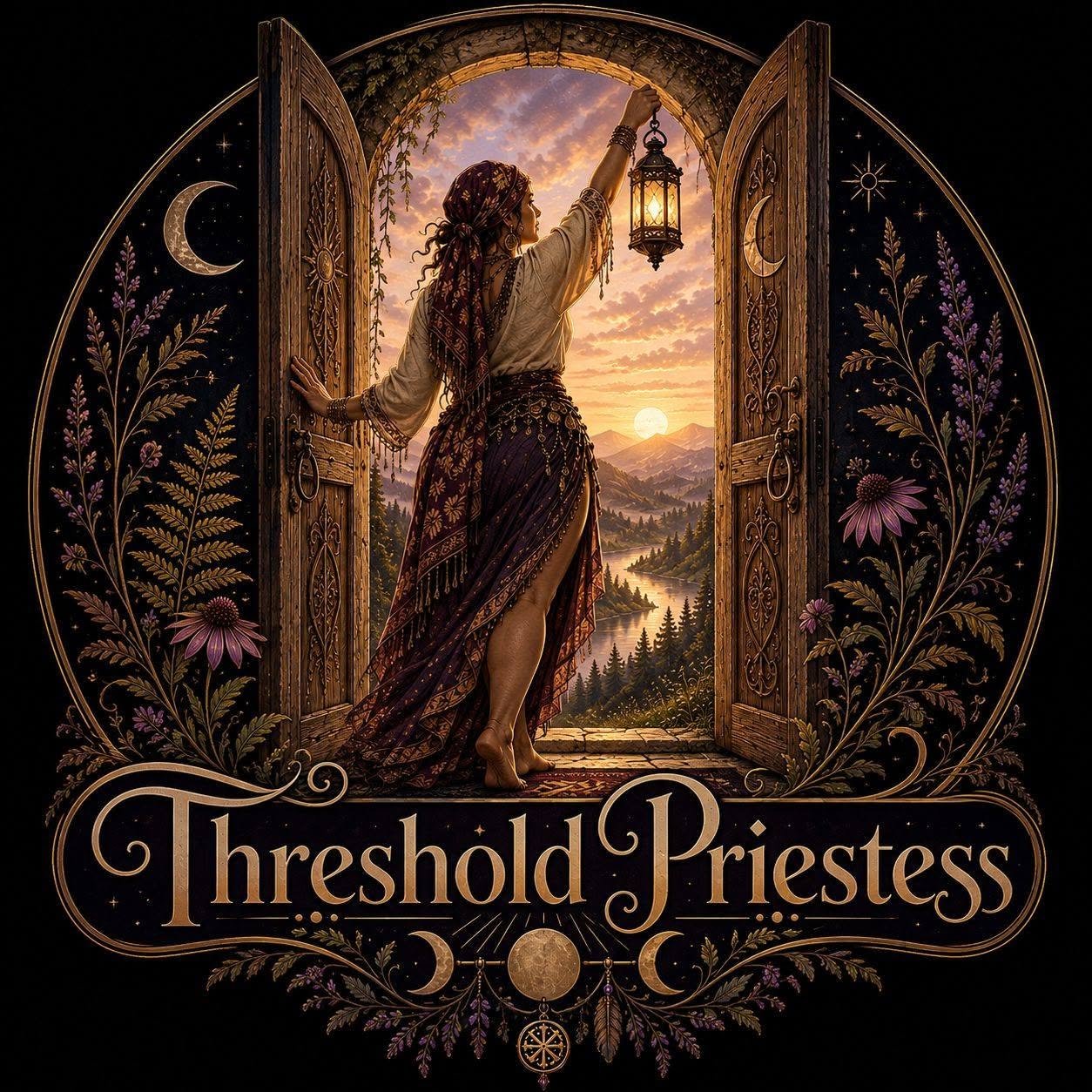
The Making of a Threshold Priestess
There is a particular kind of smallness so many of us learn early — not from one dramatic moment, but from a thousand small ones: a want dismissed, a talent quietly discouraged, a voice told it was too much. We learn to shrink ourselves down to whatever size keeps us safe, or accepted, or loved. Maybe you learned your own version of this lesson. However it arrived, you may know what it is to hide your own aliveness — your creativity, your sexuality, your ambition, your voice, your joy, your spirituality — because some part of you learned long ago that being fully yourself cost more than you could afford to pay.
I learned an extreme version of that lesson very young. In the house I grew up in, I was taught daily that I was “just a girl” — that my wants, my art, my hunger to dance and take up room were, at best, indulgences to be gently redirected, and at worst, a bother. Underneath that lesson was something far darker: my grandfather, entrusted to care for my brothers and me, took something from me that I wouldn’t have language for until I was nineteen, when the memory broke the surface at his graveside and would not let me go. I learned to hide my own aliveness so completely I nearly lost track of what it had felt like in the first place.
The years that followed held their own reckonings: a mother who, once she understood what had happened, wept and told me she was sorry she hadn’t known; a husband whose quiet, enormous love I only fully understood after he was gone; and, in my forties, the closing of a door I had always assumed would open — the chance to become a biological mother. I grieved that loss the way you’d grieve a person. On the other side of that grief, something unexpected arrived: freedom. With no more script to follow, I finally asked myself what actually made me feel alive.
The answer came through my body, on a dance floor. Freshly grieving, I was welcomed into a circle of women who became my coven — women who, like me, had been told they were too much or not enough. In ritual and movement, I learned to see the goddess in myself and in all of us. That circle didn’t just witness my grief; it began, physically, to give me my body back.
What I discovered there wasn’t a metaphor. We are whole. We are holy. Believing that, in my body and not only my mind, changed concrete things: I began to trust my own no as much as my yes, and let myself want pleasure instead of performing availability. My creativity came out of hiding and into festivals, workshops, and exhibits, where I found I could build with my hands what I’d learned in that circle: real portals for other women to walk through. I call them Gateways of the Goddess — thresholds built in ritual space, where a woman can release what she no longer needs and receive something back from spirit on the other side.
This is what I mean when I call myself a threshold priestess: not a title so much as a function — the one who holds the door open while you step out of a skin you’ve outgrown and into one still soft, not yet hardened, staying close enough that you don’t have to cross alone.
You may not share my exact story. But I’d guess you recognize the shape of it: the sense that there is more of you than you’re currently living, and that you don’t yet know how to become her. Maybe you’ve spent years being what was needed of you — the reliable one, the easy one, the one who doesn’t ask for too much — while your own aliveness waited quietly in a room you stopped visiting.
If you’re standing at your own threshold right now, unsure what you’re being asked to leave behind, that uncertainty isn’t a flaw in you — it’s simply what a threshold feels like from the inside, before you’ve crossed it. On the other side of that door is more freedom than you think you’re allowed to want: more pleasure, more trust in your own instincts, more room for the parts of you that create, desire, grieve, and celebrate.
I learned an extreme version of that lesson very young. In the house I grew up in, I was taught daily that I was “just a girl” — that my wants, my art, my hunger to dance and take up room were, at best, indulgences to be gently redirected, and at worst, a bother. Underneath that lesson was something far darker: my grandfather, entrusted to care for my brothers and me, took something from me that I wouldn’t have language for until I was nineteen, when the memory broke the surface at his graveside and would not let me go. I learned to hide my own aliveness so completely I nearly lost track of what it had felt like in the first place.
The years that followed held their own reckonings: a mother who, once she understood what had happened, wept and told me she was sorry she hadn’t known; a husband whose quiet, enormous love I only fully understood after he was gone; and, in my forties, the closing of a door I had always assumed would open — the chance to become a biological mother. I grieved that loss the way you’d grieve a person. On the other side of that grief, something unexpected arrived: freedom. With no more script to follow, I finally asked myself what actually made me feel alive.
The answer came through my body, on a dance floor. Freshly grieving, I was welcomed into a circle of women who became my coven — women who, like me, had been told they were too much or not enough. In ritual and movement, I learned to see the goddess in myself and in all of us. That circle didn’t just witness my grief; it began, physically, to give me my body back.
What I discovered there wasn’t a metaphor. We are whole. We are holy. Believing that, in my body and not only my mind, changed concrete things: I began to trust my own no as much as my yes, and let myself want pleasure instead of performing availability. My creativity came out of hiding and into festivals, workshops, and exhibits, where I found I could build with my hands what I’d learned in that circle: real portals for other women to walk through. I call them Gateways of the Goddess — thresholds built in ritual space, where a woman can release what she no longer needs and receive something back from spirit on the other side.
This is what I mean when I call myself a threshold priestess: not a title so much as a function — the one who holds the door open while you step out of a skin you’ve outgrown and into one still soft, not yet hardened, staying close enough that you don’t have to cross alone.
You may not share my exact story. But I’d guess you recognize the shape of it: the sense that there is more of you than you’re currently living, and that you don’t yet know how to become her. Maybe you’ve spent years being what was needed of you — the reliable one, the easy one, the one who doesn’t ask for too much — while your own aliveness waited quietly in a room you stopped visiting.
If you’re standing at your own threshold right now, unsure what you’re being asked to leave behind, that uncertainty isn’t a flaw in you — it’s simply what a threshold feels like from the inside, before you’ve crossed it. On the other side of that door is more freedom than you think you’re allowed to want: more pleasure, more trust in your own instincts, more room for the parts of you that create, desire, grieve, and celebrate.
This was my threshold. You may be standing at yours right now — closer to becoming her than you think. I know how to hold a door open, and how to stay close while a woman walks through it.